Commentary by Sarah Rayne
Scholars generally describe “fascism” as a form of authoritarian leadership and ultranationalism that seeks to erode democratic institutions. But what does that actually mean? And why are people using that word to describe an elected leader of a free nation?
Encyclopedia Britannica defines a few clear tenets of fascist ideology:
- Authoritarian leadership centered around a figure who claims to embody the will of “the people” and condemns democratic norms as illegitimate or corrupt, all framed as obstacles imposed by elites or enemies.
- Ultranationalism that seeks to exclude outsiders from their definition of citizenship, whether it be a racial, ethnic, religious or cultural group.
- Normalization of political violence, literal or rhetorical, through the praise of force or dehumanization of opponents.
- Mythic narratives, such as stories of national decline, betrayal and rebirth that justify authoritarian power as both necessary and redemptive.
We know these elements were present in 20th century fascist regimes, like Benito Mussolini’s Italy and Adolf Hitler’s Germany, but how could they apply to Trump’s presidency in the modern era?
The United States certainly hasn’t entered a fascist state of that caliber, but the comparisons drawn between those governments and Donald Trump’s presidency are not about mass uniforms and overt one-party rule. They’re a focus on the patterns that resemble fascism’s recurring features.
In the early 1920s, Italians didn’t wake up to welcome their own dictatorship. They woke up to newspapers warning of national humiliation, street violence portrayed as “patriotism,” and the insistence that democracy itself was weak and therefore unable to protect the nation.
One frequently cited similarity to previous fascist tactics is the delegitimization of democratic systems, like President Trump’s repeated attacks on electoral processes.
Political scholars such as Rober Paxton, author of “The Anatomy of Fascism,” have stated this maneuver serves a dual purpose. Not only does it repress public participation, it also creates a narrative wherein only results that affirm a leader’s authority are seen as legitimate.
In historical fascist movements, public faith in institutions did not disappear overnight, but dissolved slowly over time. We can observe how journalists were first cast aside as liars, causing court rulings to be met with suspicion by the public. Then when dissenters were punished in the name of safety and civil servants were alleged as saboteurs for following the law too closely, people trusted their governments for telling them so.
After President Trump’s defeat in the 2020 election, he said, “Frankly, we did win this election,” “This election was rigged,” and “We have absolute proof” despite countless courts, state officials and even his own Justice Department finding none. When various institutions refuted him, he began attacking their legitimacy, saying the Supreme Court “didn’t have the courage” to act and pressuring a state official to find 11,780 votes.
This culminated on January 6, 2020, after he repeatedly addressed his supporters with inflammatory statements, such as “We will never concede,” and “If you don’t fight like hell you’re not going to have a country anymore,” resulting in the infamous attack on the capitol where MAGA supporters stormed the building, causing the deaths of four civilians and an officer who was on duty at the time of the insurrection.
Similar patterns have been observed in President Trump’s outward perspective of the judiciary and civil service. Judges who ruled against his priorities have been labeled as “Obama judges” or “radical judges,” as actors with malicious motives. Career officials have been cast aside, again and again, for speaking in opposition to him. According to the International Association of Comparative Fascist Studies, this mirrors a classic fascist strategy. By redefining bureaucratic resistance as treason, fascist movements justify purges and replacement with personal allegiance to the leader.
Another point of comparison lies in national identity and exclusion.
Before citizenship was stripped by law, it was stripped by language. Fascist leaders spoke of “real” Italians and “true” Germans. The definitions shifted but always excluded someone. Minorities and political opponents were described not just as wrong, but as contaminating. Long before deportations or camps, there was social withdrawal. Neighbors stopped greeting one another and solidarity was replaced by silence. Fear did the ground work before policy made it mandatory.
President Trump has described undocumented immigrants as “animals” who “poison the blood of our country,” and warned that they are “invading” the United States, a direct quote of Adolf Hitler’s. He has used this sentiment to try and invoke the Insurrection Act for domestic enforcement, and proposed to reinstate Schedule F to purge civil servants he has deemed disloyal. His Administration has also worked to eliminate diversity, equity and LGBTQ+ protections, portrayed as “corruption.”
Steven Levitsky and Daniel Ziblatt, Harvard professors who are renowned for their research on the decline of democracies, note that when citizenship is moralized and dissent is seen as betrayal, belonging is no longer defined equally under law, but by loyalty to the leader. This reinforces a hierarchy where some Americans are seen as more legitimate than others based on their thoughts, concerns, identities, or cultural conformity.
Then we have the issue of political violence. According to the Association of Comparative Fascist Studies, fascism does not require the state to openly wield violence, but depends on public approval of it.
The killings of Renee Good and Alex Pretti illustrate how state sanctioned or tacitly approved violence can become a part of political culture where force and intimidation are normalized.
Good was a mother and legal neighborhood observer. She was shot on a city street by an immigration agent during a routine encounter. Pretti, an ICU nurse who was filming and attempting to protect others, was tackled and shot by multiple agents despite appearing not to hold a gun at the time of his murder. Good and Pretti were first described as threats to public safety, however video and eyewitness accounts have contradicted this.
The portrayal of both shootings as threats by the federal government, as well as their resistance to transparent investigations into the use of deadly force, sends a message that violent outcomes for dissent will be excused rather than punished or prevented.
Paxton’s “The Anatomy of Fascism” has identified this interaction as a fascist mechanism, where the boundary between lawful authority and arbitrary force is obscured. In early fascist regimes, violence was not framed as punishment, but as necessity. Victims were first described as threats, then erased as citizens, then dismissed as unfortunate but unavoidable losses.
President Trump has also been observed using a “mythic narrative,” a storyline which Roger Griffin, renowned scholar and history professor at Oxford University, has described as “palingenetic ultranationalism,” resembling fascist movements.
In this type of narrative, blame is placed on internal enemies, such as elites, institutions, the media, immigrants, and political opponents, who undermine the country from within. President Trump portrays himself as the unique figure for national rebirth, emblemizing both federal buildings and public infrastructure with his name and face, including most recently The John F. Kennedy Center for the Performing Arts. He is known for his cult of personality, framing the present as catastrophic to justify radical change, saying, “I alone can fix it.”
This shifts loyalty away from democratic institutions and toward personal authority. It makes the bypassing of local governance and other rule breaking or authoritarian measures seem imperative or entirely redemptive.
Unlike classic dictatorships, fascism does not rely only on repression, but also participation. It invites the public to believe in it, a nation under siege with one leader as its only defender, using any means necessary to lead us to greatness.
But there are also critics who claim that the United State’s active civil society and contested elections, though widely recognized as a fragmented system, make any direct equivalence to fascism complicated. What they don’t understand is that the concern is not about the label. It’s about the patterns. Fascism, as history has shown us, doesn’t announce itself as a break in democracy, but instead asks for small compromises: a little less scrutiny, a little more loyalty, a little more tolerance for force in the name of safety. The question is not whether a nation ever calls itself fascist, but how many people decide that the erosion is tolerable, because it is not yet happening to them.
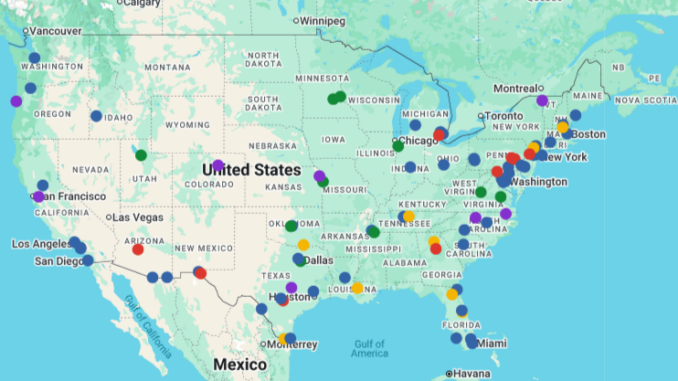
Editor’s note: Project Salt Box is an initiative led by citizens to track where ICE/DHS are planning, leasing or buying industrial warehouses that could be converted into large-scale detention sites. The Project Salt Box website specifically monitors whether those projects have been cancelled or if they are moving forward. Please check their map and database for updates, as their site is a real-time paper-trail tracker for procurement records and local government notices.
If there are sites near you, consider urging your representatives to block their initiatives by speaking to them at:
- City council meetings
- County commissioner meetings
- Planning or zoning board hearings
- Environmental review sessions
Or call your Washington State legislators and make your voice heard!