By Sarah Rayne
Alex Pretti lay dying on the frigid pavement of Nicollet Avenue after being shot and killed by federal immigration agents on the morning of January 24th. While many Minnesotans were barely stirring awake in the comfort of their beds, the 37-year-old ICU nurse and University of Minnesota (UMN) alumnus stood watching and recording a federal immigration enforcement operation. According to multiple video analyses and witness accounts, he stepped in to help a woman who had been shoved to the ground moments before he was surrounded, restrained, and shot during the confrontation. Pretti’s death marks the second fatal shooting by immigration enforcement in the previous three weeks, the first being Renee Good, 37-year-old mother of three, on January 7th.
Authorities initially claimed Pretti posed an armed threat and framed the killing as self defense, but this story has been heavily scrutinized as videos and witness accounts circulated online. Instead, a web of contradictions and mounting public anger has emerged. What actually happened in those final seconds, and why did it end with a man dead in the street?
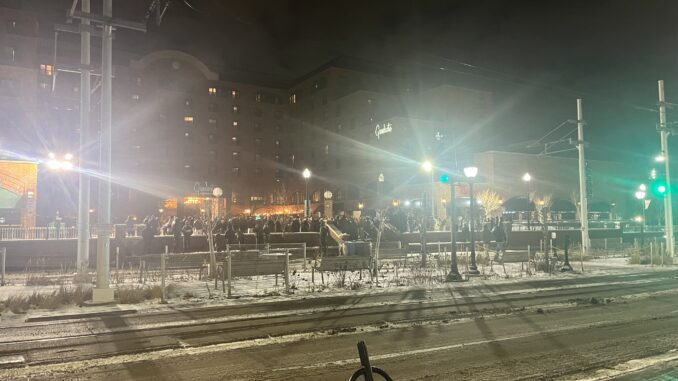
This sentiment spread rapidly across the University of Minnesota’s (UMN) campus. Students have come together to organize protests against federal immigration enforcement across the Twin Cities, including “noise demonstrations” outside the Graduate Hotel, which was confirmed to be lodging federal immigration agents. These protests, coordinated by Students for a Democratic Society (SDS), ended in arrests by University police (UMPD). SDS stated that this merely confirms what they already believed, that the university is “more interested in protecting its image than its most vulnerable students.”
An anonymous SDS organizer said the university’s response to recent protests showed “exactly whose safety they prioritize,” adding, “real safety doesn’t come from more police or federal agents. It comes from the university refusing to cooperate with the same system that’s terrorizing our classmates.”
For SDS, the shooting of Alex Pretti isn’t some isolated tragedy, it’s proof that the stakes are already life and death, and that UMN can no longer act like it’s someone else’s problem. However, for some students, the protests themselves have become yet another source of fear.
An anonymous international student at the university said the protests have only intensified their fear of leaving their housing. While demonstrators see the marches as acts of solidarity, the student said the increased police presence and immigration enforcement activity make visibility feel dangerous. They described avoiding public spaces, including the UMN campus, and trying to pursue alternate methods of attendance, such as transitioning to online classes. Because their residence isn’t far from the Graduate Hotel, they described having nightmares on at least three occasions of immigration agents entering their apartment. “I put a suitcase in front of my door so I can hear it move if anyone comes in.” they said.
Even though they are residing in the country legally, they fear any possible complications to their visa status that could occur from being associated with the noise demonstrations. Even the UMN website emphasizes the importance of knowing the “risks,” warning, “it is possible that participation in a protest or demonstration could be viewed negatively by some government officials.”
For some students, protest is a moral necessity, but for others, survival means staying invisible. As investigations into the January shootings continue, and federal agents remain present in the Twin Cities, the university has yet to clearly define where it stands or how it intends to protect students caught between fear of enforcement and fear of being seen.
“The University of Minnesota Police Department will not be involved in enforcing ICE operations and the University does not provide data unless ICE officials have a federal court subpoena or warrant,” said Greg Goldman, UMN Executive Vice President.
UMN officials have also stated they would “comply with federal court orders” and, following the revocation of “sensitive location” protections for colleges by the federal government, the university adjusted to a reality where ICE agents could legally enter campus. SDS argued that this compliance, despite public safety concerns during ICE-involved shootings of Good and Pretti, made the “safe campus” rhetoric ring hollow.